BIONICS
Bionics represent the cutting-edge fusion of biology and robotics, creating lifelike humanoids (or androids) that mimic human form and function at a profound level. Unlike traditional rigid robots, bionic humanoids feature:
- Bio-inspired structures — synthetic "muscles," flexible spines, and compliant joints for fluid, natural movement.
- Soft, warm synthetic skin — enabling realistic touch, facial expressions, and seamless human interaction.
- Biomimetic intelligence — embodied AI that perceives, adapts, and responds like living beings. Pioneered in models like XPeng's IRON (with its bone-muscle-skin system), DroidUp's Moya, EX Robots' bionic series, and Realbotix Harmony, bionics bridge the gap between machine and human—delivering hyper-realistic companions for companionship, service, and beyond.
Welcome to the era where robots feel alive.
XPENG's IRON ANDROIDS
XPeng's Iron Androids: A Leap in Robotics
XPeng, the Chinese electric vehicle manufacturer, unveiled its next-generation IRON humanoid robot on November 5, 2025, during the company's AI Day event. This advanced bipedal robot represents a significant evolution from its first-generation predecessor, which was released in 2024. The IRON robot made its first public appearance on January 31, 2026, at a shopping mall in Shenzhen, China, where it demonstrated its walking capabilities before an unexpected fall, which the company's CEO, He Xiaopeng, described as part of the "learning to walk" process. This incident highlighted the challenges in achieving stable humanoid locomotion but also underscored XPeng's commitment to real-world testing.
The IRON robot stands at 1.73 meters tall and weighs approximately 70 kilograms. It boasts 82 degrees of freedom across its body, enabling natural and flexible movements that mimic human actions, such as a lifelike catwalk gait. Each hand features 22 degrees of freedom in a 1:1 human-scale design, allowing for precise manipulation. The robot incorporates a humanoid spine, bionic muscles, and fully covered flexible skin, which supports customization for different body shapes. Powering the IRON is an all-solid-state battery, marking a first in humanoid robotics for lightweight, high-energy-density, and enhanced safety.

At its core, the IRON integrates three Turing AI chips, delivering an effective computing power of 3000 TOPS. It is equipped with XPeng's first-generation physical world large model, enabling cross-domain applications shared with the company's AI cars and flying vehicles. The robot combines high-order intelligences through VLT (Vision-Language-Task), VLA (Vision-Language-Action), and VLM (Vision-Language-Model) systems, facilitating conversation, walking, and interaction. The VLT large model serves as the engine for autonomous decision-making and actions. For safety, XPeng adheres to the classic Three Laws of Robotics and adds a fourth: ensuring privacy data never leaves the robot.
Training the IRON has been revolutionized; it can learn complex movements, like hip twists via its bionic spine, in just two hours using a large model framework, compared to weeks with traditional reinforcement learning. The robot's "Eagle-Eye" system provides 720-degree vision for spatial awareness, and it is already deployed in XPeng's internal operations for tasks like factory assistance.

In terms of applications, XPeng prioritizes commercial scenarios for the IRON, including guided tours, shopping assistance, and traffic management. It is set to be stationed at Baosteel for industrial inspections, exploring complex manufacturing environments. To foster innovation, XPeng plans to open an SDK for developers to build a broader ecosystem around the robot.
Looking ahead, XPeng aims for large-scale mass production of the IRON by the end of 2026, with preparations beginning in April 2026. This timeline positions the robot for deployment in retail, security, and reception roles. The company's "Physical AI Emergence" strategy integrates the IRON into a future mobility landscape, blending robotics with autonomous vehicles.
The IRON's development addresses key challenges, such as data scarcity—XPeng established the first embodied intelligence data factory in Guangzhou—and mass production hurdles through self-research and integration. While the robot's lifelike design has sparked viral moments, like the CEO cutting it open on stage to dispel doubts of it being a human in disguise, it signals a new era in humanoid robotics. For more details, visit XPeng's official site: https://www.xpeng.com/news/019a56f54fe99a2a0a8d8a0282e402b7.

DROIDUP MOYA
The World's First Biomimetic Androids
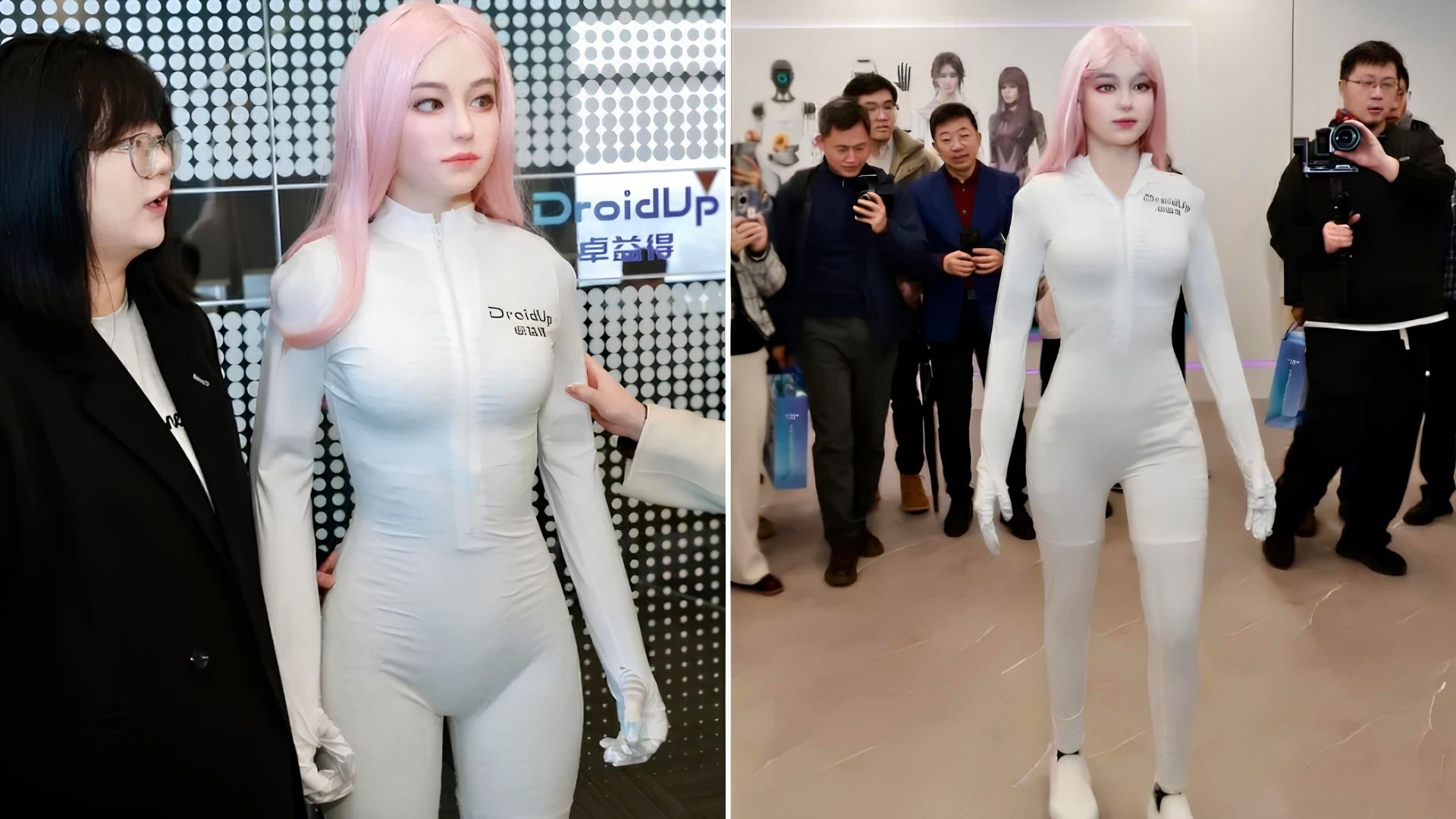
In late January 2026, Shanghai-based startup DroidUp unveiled Moya, hailed as the world's first fully biomimetic embodied intelligent robot. This groundbreaking humanoid made its debut at the company's relocation ceremony, marking a significant advancement in robotics by blending human-like aesthetics with AI-driven interactions. Unlike traditional robots, Moya is designed to perceive, reason, and physically engage with the real world, moving beyond digital-only functions. The robot's lifelike qualities have sparked widespread discussion, with some praising its realism while others note its uncanny valley effect.
Moya stands at 1.65 meters tall and weighs approximately 32 kilograms, proportions close to an adult human. A standout feature is its body temperature, maintained between 32°C and 36°C, enhancing its human-like presence through warm, plasticky skin. Cameras embedded behind the eyes enable visual perception, while a high-degree-of-freedom bionic head allows for subtle micro-expressions like smiling, nodding, and eye contact. The robot's modular design permits customizable appearances, including gender characteristics, without altering the internal mechanical structure. Powered by DroidUp's cerebellar motion control model, Moya achieves fluid movements, with a walking posture boasting 92% accuracy compared to human gait. This is built on the 'Walker 3' skeleton, an evolution from a model that earned bronze in Beijing's first robot half-marathon in April 202

At its core, Moya integrates advanced AI for embodied intelligence, enabling natural interactions and responses with human-like charm. Founder Li Qingdu emphasized that "a robot that truly serves human life should be warm... almost like a living being that people can connect with." This positions Moya for applications in healthcare, education, and commercial environments, such as providing consultations, route guidance, or information at train stations, banks, museums, and shopping malls. It also holds potential as a daily companion, fostering long-term human-robot relationships.
Compared to contemporaries like XPeng's Iron humanoid, which debuted its catwalk-like gait but stumbled publicly on January 31, 2026, Moya prioritizes biomimetic subtlety over dramatic mobility. While Iron focuses on industrial and mobility integration, Moya's design emphasizes approachable, service-oriented roles, avoiding the "steel image" of rigid robots.
DroidUp plans to release Moya to the market in late 2026, with an initial price of ¥1.2 million, approximately $173,000. This positions it as a premium option for sectors needing interactive AI, though its creepiness—described by some as a "deterrent for burglars"—may limit home adoption. The robot's development reflects China's rapid robotics progress, alongside models like Unitree G1 and EngineAI's PM01.
For more information, visit DroidUp's official website: www.droidup.com. Additional details can be found in coverage from TechRadar: https://www.techradar.com/computing/the-worlds-first-biomimetic-ai-robot-just-strolled-in-from-the-uncanny-valley-and-yes-its-super-creepy.

REALBOTIX ANDROIDS
Pioneering Companionship Androids
RealBotix, a leader in AI-powered humanoid robotics, focuses on creating robots for companionship, entertainment, and customer service. The company evolved from Abyss Creations, known for RealDoll sex dolls, and was acquired in July 2024 by Tokens.com to form the publicly traded RealBotix (OTC: XBOTF). This transition shifted emphasis from adult novelties to broader applications like healthcare, hospitality, and retail, aiming to enhance human experiences through connection and learning.
One of RealBotix's early breakthroughs was Harmony, a conversational AI robot head integrated with RealDoll bodies, first prototyped around 2017. Harmony featured customizable personalities and facial expressions, marking a pivot toward embodied AI.
At CES 2025, RealBotix unveiled advanced models like Aria and Melody. Aria, the flagship full-bodied robot, emphasizes social intelligence and realistic interactions, with a rolling base for mobility since walking isn't fully implemented. Melody, an open-source modular design, offers smoother movements, easy disassembly for suitcase storage, and object recognition for natural engagements.

RealBotix's current lineup includes three series. The B-Series is a robotic bust starting at $20,000, ideal as a tabletop concierge. The M-Series, a modular paneled body robot, begins at $95,000, allowing quick customization. The F-Series full-bodied model starts at $125,000, with advanced features for public interactions. Earlier reports from CES 2025 cited busts at $10,000-$12,000, modular at $150,000, and full-standing at $175,000, but official pricing reflects adjustments for broader markets. A $199 monthly enterprise monitoring subscription supports ongoing operations.
Key features include patented skin technology refined over 20 years for lifelike feel, interchangeable faces with 14+ movable points for expressions, and embedded eye cameras for face/voice recognition. Robots are AI-agnostic, compatible with various platforms, and powered by RealBotix's companionship AI for emotional conversations. In February 2025, RealBotix launched its Robotic AI Vision System, enhancing real-time awareness, with beta demos at CES 2025 and fall 2025 deliveries. Retrofits are available for existing models.
Applications span customer service, healthcare (e.g., hospitals), and entertainment (e.g., theme parks), with multilingual capabilities demonstrated at CES 2026. Delivery timelines are as short as 12 weeks after customization. For more, visit the official site: https://www.realbotix.com/.

EX ROBOTS
Hyper-Realistic Bionic ANDROID
EX Robots, officially Dalian Tis Tech Development Co., Ltd., was founded in July 2013 in Dalian, China, as a high-tech enterprise specializing in intelligent bionic humanoid robots. The company, listed on the New Third Board, focuses on R&D, production, sales, and service of robots that mimic human appearance and behavior. Earlier accounts suggest the parent entity began in 2009, with humanoid robot research starting in 2016. By 2021, EX Robots opened China's first robot museum, showcasing their advancements. The firm aims to integrate robots into diverse scenarios, creating clusters around technology, education, culture, and entertainment.
EX Robots' humanoids are renowned for hyper-realistic features, including lifelike skin, facial expressions, and emotional displays like smiling or frowning. They incorporate mechanical bionics with AI, using a proprietary multi-motor collaborative control ROS operating system and TOF depth cameras for capturing movements and expressions. Robots can replicate subtle human gestures, powered by sophisticated AI for interaction and learning. A key milestone was their appearance at the 2022 World

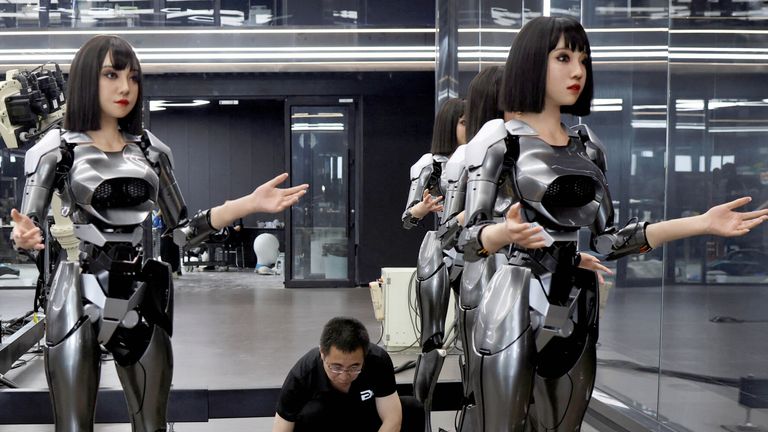
Production occurs in their Dalian factory, where engineers refine expressions and assemble units. Each robot takes two weeks to a month to build, with prices ranging from 1.5 million yuan (approximately $210,000 USD) to 2 million yuan ($280,000 USD). While no specific model names like "EX Machina" are officially detailed on their site, their robots are customizable for various roles. Applications span public services, entertainment, education, retail, and medical care, including theme park guides, venue hosts, family assistants, and healthcare aides.
In 2021, EX Robots participated in the World Robot Conference and Global Industrial Internet Conference, earning honors in AI competitions. They assisted in Dalian's anti-epidemic efforts with tech deployments. By 2022, their Jinshitan EX Robot Science and Technology Museum was designated a national demonstration project, and they featured in media like CGTN and CCTV.
EX Robots' innovations extend to metaverse-integrated museums, fusing tech with tourism and dining. In 2024, factory tours revealed rows of partially assembled humanoids, emphasizing emotional AI. The company continues bulk production, positioning itself as a leader in service-oriented robotics.
For more, visit the official site: https://www.exrobots.net/. Additional coverage at The Telegraph: https://www.telegraph.co.uk/world-news/2024/06/11/china-hyper-realistic-robots-shoe-emotion-ai-exrobots.

Comprehensive List of Hyper-Realistic Humanoid Robots in Development Worldwide (2026)
As of February 2026, the field of hyper-realistic humanoid robots—often referred to as androids due to their lifelike appearance and behaviors—is advancing rapidly, particularly in applications for companionship, education, healthcare, and entertainment. These robots feature advanced AI, realistic skin, facial expressions, and sometimes even body heat to mimic humans closely, often venturing into the "uncanny valley." While a complete exhaustive list is challenging due to ongoing developments and proprietary projects, here are some of the most prominent ones based on recent reports and unveilings. I've focused on those described as hyper-realistic or biomimetic, including details like development status, costs, and release dates where available.
1. Moya by DroidUp (Shanghai, China)
Unveiled in late January 2026, Moya is touted as the world's first fully biomimetic embodied intelligent robot. It stands 1.65 meters tall, weighs 32 kg, and maintains a body temperature of 32-36°C with realistic synthetic skin and subtle micro-expressions. Designed for healthcare, education, and commercial services, it achieves 92% human-like walking accuracy. Market release is planned for late 2026 at approximately ¥1.2 million ($173,000).
More info: TechRadar
2. Ameca by Engineered Arts (UK)
Ameca, developed since around 2021, is described as the world's most advanced social humanoid robot with 61 degrees of freedom for lifelike movements and expressions. It features modular design for customizable appearances and integrates AI for natural interactions. Available for purchase or rental, with pricing starting around $100,000+ for full models. It's used in entertainment and research, with ongoing enhancements in 2026.
Official site: Engineered Arts
3. Sophia by Hanson Robotics (Hong Kong)
First activated in 2016, Sophia remains one of the most famous hyper-realistic androids, with lifelike skin, facial expressions, and AI-driven conversations. In 2026, updates focus on improved emotional intelligence and integration with new AI models. It's deployed in events, education, and media, with costs estimated at $100,000-$200,000 for custom units.

4. Mesmer Series by Engineered Arts (UK)
The Mesmer line, including models like Desdemona, emphasizes hyper-realistic human replication with patented skin technology and interchangeable faces. Developed over 20 years, these are used for entertainment and customer service. Pricing starts at $20,000 for bust models, up to $125,000 for full-bodied versions, with deliveries as short as 12 weeks.

5. RealBotix Robots (e.g., Aria, Melody) by RealBotix (USA)
Evolving from RealDoll since 2017, RealBotix's lineup includes full-bodied hyper-realistic robots for companionship and service. Features include silicone skin, face/voice recognition, and AI-agnostic compatibility. Unveiled advancements at CES 2025/2026. Costs: B-Series busts from $20,000, M-Series modular from $95,000, F-Series full-bodied from $125,000, plus $199/month subscription.

Official site: RealBotix
6. EX Robots Humanoids by Dalian Tis Tech (China)
Founded in 2013, EX Robots produces hyper-realistic bionic humanoids with emotional AI, lifelike skin, and expressions. Used in museums, retail, and healthcare. Each unit takes 2-4 weeks to build, priced at 1.5-2 million yuan ($210,000-$280,000). Ongoing production in 2026 for service roles.
Official site: EX Robots
7. Pedia_Roid by Tmsuk (Japan)
Developed in collaboration with dental schools, this hyper-realistic child-sized robot simulates tantrums and behaviors for training medical professionals. Features lifelike movements and expressions. In use since around 2020, with refinements continuing in 2026. Pricing not publicly detailed, but targeted at educational institutions.
8. Erica by Hiroshi Ishiguro Laboratories / Osaka University (Japan)
Created in 2015, Erica is a lifelike android with advanced conversational AI, used as a news anchor and companion. In 2026, focus on integrating more physical interactions. Costs for similar models estimated at $200,000+.

9. Anniwit Robotics Humanoid (Japan/USA)
Unveiled in early 2026 at Tokyo Expo, this robot incorporates real human-like skin technology for enhanced realism. Aimed at commercial applications, with first units expected later in 2026. Details on cost and exact release are emerging.
10. AnyWit Hyper-Realistic Robot (China)
Showcased in 2026 as a pop singer android, emphasizing lifelike performances and interactions. Part of broader hyper-realistic developments, with potential for entertainment deployment. Specific costs and dates not confirmed.
Other notable mentions include Realics' lifelike humanoid (solving uncanny valley issues) and Engine AI's T800 (athletic but with realistic elements), though they lean more toward functional realism. Developments in Japan and China dominate, with over 30-50 companies worldwide active in humanoid robotics, many incorporating hyper-real features. For the latest, check sources like Robozaps Blog or TechRadar.